Real Money Casino Table Games in Australia
 Available in AU
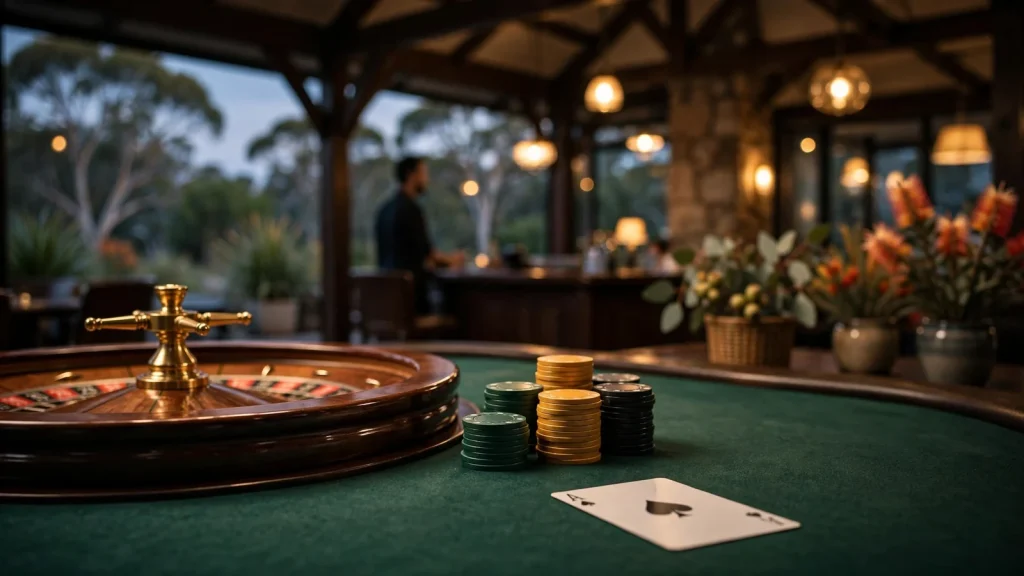
Live-dealer games stream physical equipment, while digital versions use an RNG to determine outcomes such as dealt cards or roulette results.
Table of Contents
- How Online Table Games Produce Each Result
- Bitcoin Table Games and the Limits of Comparison
- What the Available Facts Can—and Cannot—Say About Odds
- How Table-Game Decisions and Outcomes Work
- Finding a Casino with Table Games Near You
- What Counts as a Casino Table Game?
- Recognising Different Table-Game Formats
- How Card-Based Table Games Differ
- Roulette Layouts and the Role of the Zero
- Poker’s Objective at the Table
- Casino Games
How Online Table Games Produce Each Result
An online table game can present a similar screen whether its result comes from a physical casino setup or from software. The important difference is the mechanism behind the video and the outcome. In a live-dealer format, a real dealer operates real casino equipment, and a live video feed carries the action to players. In a digital version, a Random Number Generator (RNG) determines the result, such as which cards are dealt or where a roulette ball lands.
Live dealer: a streamed physical game
A live-dealer game connects a camera view of a real table to an online interface. The dealer and equipment are physically present; the stream shows the action as it happens. The screen therefore reflects a game conducted with real objects rather than an outcome generated solely by software.
The stream is the way you observe that physical process. It does not turn the game into a digital simulation: the dealer handles the equipment, while the online interface delivers the video to you. This distinction concerns how the result is produced, not whether the game is available lawfully to a person in Australia. A live camera feed does not change the legal status of an online casino service.
If you’re considering real-money casino table games in Australia in 2026, this list gives you a concise starting point for checking operator details. Review the information that matters to you before deciding where to play.
1. 7Bit Casino
License: Curacao, operated by Dama N.V. 7Bit Casino is listed with a Curaçao license and is operated by Dama N.V.
2. Bizzo Casino
License: Curacao Gaming Control Board (TechSolutions Group N.V.) Bizzo Casino is listed with a Curaçao Gaming Control Board license, with TechSolutions Group N.V. identified as the operator.
3. House of Pokies
License: international iGaming licence – jurisdiction not named in the source · Payout speed: PayID 1-24 hours · Min. deposit: A$30 (PayID from A$10) House of Pokies lists PayID payouts at 1–24 hours and a A$30 minimum deposit, or A$10 when using PayID. Its source describes the license as international but does not name the jurisdiction.
4. LuckyVibe
License: Curacao Gaming Control Board OGL/2023/176/0095 (Hollycorn N.V.) LuckyVibe is listed with Curaçao Gaming Control Board license OGL/2023/176/0095 and is operated by Hollycorn N.V.
5. Roby Casino
License: Curacao eGaming (Roby Games Ltd) Roby Casino is listed with a Curaçao eGaming license, with Roby Games Ltd identified as the operator.
6. Kingmaker
Payout speed: crypto ~90 minutes, fiat 1-5 days · Min. deposit: A$30 Kingmaker lists crypto payouts at approximately 90 minutes and fiat payouts at 1–5 days. Its minimum deposit is A$30.
7. Golden Pokies
License: Curacao Golden Pokies is listed with a Curaçao license.
8. GoldenCrown
License: Curacao Gaming Control Board OGL/2023/176/0095 (Hollycorn N.V.) GoldenCrown is listed with Curaçao Gaming Control Board license OGL/2023/176/0095 and is operated by Hollycorn N.V.
9. SpinsUp
License: Curacao Gaming Control Board OGL/2023/174/0082 (Dama N.V.) SpinsUp is listed with Curaçao Gaming Control Board license OGL/2023/174/0082 and is operated by Dama N.V.
10. JustCasino
License: Curacao Gaming Control Board JustCasino is listed with a Curaçao Gaming Control Board license.
Digital game: software determines the result
In a digital table game, software determines the outcome through an RNG. For a card game, the system selects the cards dealt; for roulette, it determines where the ball lands. The displayed result is therefore generated by the software rather than shown as the consequence of a dealer physically handling cards or a roulette wheel.
The visual design may resemble a casino table, but appearance alone does not establish how a result was produced. The useful distinction is whether the game streams a dealer and equipment in action or uses software to generate the outcome. Both formats can be presented through an online interface, yet their underlying processes differ.
This also explains why the word “live” describes more than a screen style. In a live-dealer game, the video comes from a real dealer and real equipment. In a digital game, an animation or table layout may represent the result, but the RNG is responsible for determining it. The interface shows the game to you; it is not, by itself, the mechanism that decides the result.
The Australian legal boundary
The production method does not override Australian law. Section 5 of the Interactive Gambling Act (IGA) prohibits operators based in Australia from offering residents real-money interactive casino games. That restriction concerns the service being offered, not whether its table is physical, streamed or rendered by software.
3-Reel Slots in Australia: RTP, Reels and Play
The Australian Communications and Media Authority (ACMA) is responsible for enforcing the rules and takes action against unlicensed domestic platforms, including blocking them. A live-dealer stream should not be mistaken for an exception: showing a real dealer does not make an online casino service lawful for Australian residents. Nor does software-generated play create a different permission simply because no physical table is visible.
This context matters when interpreting descriptions of real-money casino table games online. “Live dealer” and “digital” identify different ways results are produced; neither label is a statement that a service is authorised for use in Australia. The format tells you what is happening behind the interface, while the law governs whether an operator may provide the service to residents.
Searches for free table games or promotions raise a separate question from how an outcome is generated. A free-play label would not alter the distinction between a streamed physical game and an RNG-based one, and it would not change the legal status of real-money services. It is the nature of the service and the applicable Australian rules—not the presentation, promotional wording or presence of a live feed—that determine the legal context.
When you assess a table-game screen, separate three things: the visible interface, the process that produces the result, and the legal status of the service. A camera view can show a real dealer operating equipment; a digital display can show an RNG-determined outcome. Those are differences in game production. They do not, on their own, establish whether the service may lawfully be offered to people in Australia.
Legal Restriction
Section 5 of the Interactive Gambling Act prohibits operators based in Australia from offering real-money interactive casino games to residents.
Bitcoin Table Games and the Limits of Comparison
Bitcoin is a payment-related term, while a table game describes how play is organised and how an outcome is produced. Those are separate parts of an online service. Asking about bitcoin table games therefore does not, by itself, identify a different kind of blackjack, roulette or other table-game mechanic. It identifies an interest in Bitcoin alongside table-game play.
For an online software version, the outcome is determined by a Random Number Generator (RNG). The software uses it to determine, for example, which cards are dealt or where a roulette ball lands. That describes the result mechanism. A payment method is a separate matter: its name does not explain how the game selects cards or a roulette result. Nor does it establish that a particular game accepts that method, or that one version produces different outcomes from another.
This distinction matters when comparing Bitcoin table games with what someone might call ordinary casino table games. “Bitcoin” alone does not tell you whether a game is software-generated or streamed with a live dealer, what rules it follows, or how its result is produced. Those details belong to the game format and its rules, not to the payment label. To compare mechanics, you would need information about the actual game and format; a cryptocurrency label is not a substitute for that information.
It also does not support naming a best Bitcoin option or a best table game in general. A payment preference cannot establish which game is suitable, and the term does not reveal anything about the quality or fairness of a game. For a software game, the useful mechanical question is how its result is generated. The answer is that the RNG determines the cards dealt or the roulette ball’s landing place. The payment term does not provide another outcome rule.
Mines Casino Game in Australia: Legal and Demo Guide
There is an important Australian legal boundary as well. The Interactive Gambling Act 2001 prohibits operators from providing real-money online casino games to people located in Australia. That includes online table games. The fact that a service refers to Bitcoin does not change the legal status of the underlying real-money casino service. This is not a recommendation to seek out a platform using a particular payment method; the payment label cannot make prohibited provision lawful.
The same boundary applies whether a page describes a game as a Bitcoin table game, a cryptocurrency casino game or simply an online casino game. These labels may draw attention to different aspects of a service, but they do not alter what the service offers. For readers in Australia, it is therefore important to separate a description of game mechanics from a claim about payment: neither wording makes real-money online casino play a lawful service for operators to provide to people in the country.
If you encounter a comparison framed around Bitcoin versus ordinary casino table games, check what is actually being compared. A payment method and an outcome mechanism are not equivalent categories. The available mechanical description is limited but clear: software-generated online table-game outcomes can be selected by an RNG, including dealt cards and roulette’s ball position. Nothing about the word “Bitcoin” supplies a different rule for those outcomes.
That distinction keeps the comparison precise. Bitcoin-related wording can indicate the subject of a payment question, but it cannot answer how a table-game result is generated, establish that a game accepts Bitcoin, or identify a best option. For Australian readers, it also cannot override the prohibition on operators providing real-money online casino games to people in Australia.
A payment label like "Bitcoin" does not reveal the game’s quality, fairness, or whether the outcome is generated by an RNG or a live dealer.
What the Available Facts Can—and Cannot—Say About Odds
A label such as “best odds” needs a defined measure. It might refer to the chance of a particular outcome, the amount paid when that outcome occurs, or the expected proportion of stakes returned over repeated play. These measures are related, but they are not interchangeable. A game can offer several possible bets, each with its own outcome and payout structure, so a single label may conceal important differences.
A house-edge chart is useful only when its entries are measured on a comparable basis. To interpret one, you would need to know which rules apply, which bet is being assessed and how the percentage was calculated. A figure without those details can look precise while comparing unlike things. It also cannot tell you what will happen in an individual round: a long-run measure describes repeated play, not a guaranteed result for a particular player.
The stated mechanics alone do not produce that kind of comparison. In blackjack, the player competes with the dealer to make a hand whose value is closer to 21. That describes the contest’s objective, but not the probability of each result or the expected return associated with a particular set of rules. For another hand-based game, a player may bet on their own hand, the Banker’s hand or a tie. Those are distinct choices, but the choice labels do not establish which one has the strongest odds.
This is why naming a game as the best-odds option—or calling another the worst—would require more than knowing its broad format. The comparison has to be between defined bets under specified conditions, using the same type of probability or return measure. Otherwise, a ranking may combine different questions: the chance of winning, the size of a payout and the expected result over time.
Crash Casino Games in Australia: How They Work
The same caution applies to a table-games odds chart. Before relying on one, check whether every entry concerns the same kind of bet and whether its rules and measurement basis are stated. If a chart gives only a game name and a percentage, you cannot tell from that alone what outcome the figure represents or whether it applies to the version you are considering. A “best odds” ranking without those details is not a reliable guide to comparing play.
There is therefore no sound way to infer a universal winner from the basic mechanics described here. Blackjack’s target and the available hand, Banker and tie bets identify what is being played or selected; they do not supply comparable house edges or return percentages. Treating those mechanics as if they establish a ranking would turn a description of play into a claim about probability.
For a useful comparison, the relevant information would need to connect a specific bet and rule set to a clearly defined odds measure. Until those pieces are stated together, “best” and “worst” are labels without a dependable numerical basis.
How Table-Game Decisions and Outcomes Work
The key difference between table games is what you act on and what determines the result. In blackjack, you compare a hand with the dealer’s. In games that let you bet on hands, your choice is which hand or tie to back. With dice, you wager on a roll’s outcome. In poker, players compete to make the strongest hand. These structures describe different ways a round is organised; they do not make one game inherently better than another.
Blackjack
Compare your hand value with the dealer’s to get closer to 21.
Hand Betting
Select whether to back your own hand, the Banker’s hand, or a tie.
Dice Games
Wager on the specific outcome of a roll of a pair of dice.
Poker
Compete against other players to build the strongest possible poker hand.
Blackjack: compare your hand with the dealer’s
In blackjack, your objective is to finish with a hand value closer to 21 than the dealer’s. The contest is between your hand and the dealer’s hand, rather than between your hand and every other player’s. That comparison gives the round its basic shape: each side has a hand, and the result depends on which is nearer to the target value.
If you are learning how to play, start by understanding that objective before considering any other detail. It tells you what the game is measuring, but it does not by itself describe every action available during a round. The important point here is the comparison: your hand is assessed against the dealer’s, with closeness to 21 as the stated aim.
Betting on a hand, the Banker, or a tie
Some table games organise a wager around which hand will prevail. You can bet on your hand, the Banker’s hand, or a tie. Your decision is therefore about selecting the outcome you want to back, not about building a poker hand or bringing dice to a particular result.
That distinction matters when you are trying to understand a game’s decision structure. In blackjack, the focus is the player’s hand against the dealer’s and the target value. In a hand-betting game, the available choice is which of the named outcomes to support. The wager and the comparison between hands are related, but they are not the same kind of decision.
Dice: bet on the roll’s outcome
A dice-based table game centres on a pair of dice being rolled. Players place bets on the outcome, so the key event is the roll and the key decision is which result to wager on. The sequence is straightforward at a structural level: choose an outcome, roll the dice, then compare what happened with the wager.
Casino Dice Games in Australia: How They Work
This is different from a hand-based contest. You are not trying to make a hand closer to a target, and the described objective is not to build a hand stronger than another player’s. Instead, the dice produce the event your bet depends on.
Poker: build the strongest hand
Poker is organised around players competing to build the best possible poker hand. The central task is hand construction: the result of the contest turns on the strength of the hands players make. Unlike blackjack’s comparison with the dealer’s target, poker is framed as competition among players.
For a first look at how table games work, separating these structures is more useful than treating them as interchangeable. Blackjack asks you to compare your hand with the dealer’s; hand betting asks which outcome you support; dice betting centres on a roll; and poker centres on competing hands. These are the basic decision and outcome patterns that distinguish the games during play.
Finding a Casino with Table Games Near You
Finding a nearby casino is a question about physical location: the answer depends on where you are and which venues operate within a practical distance. It is separate from how an online table game deals cards, rolls dice or determines a result. A venue’s distance from you also does not establish whether it offers a particular game or whether you can legally access that game.
Attention: A physical casino and an online casino are not interchangeable; distance to a venue does not establish the legality of online gambling rules.
In Australia, the legal distinction matters. The Interactive Gambling Act 2001 prohibits operators from providing real-money online casino games to people physically located in Australia. That prohibition covers online casino-style services such as blackjack, roulette and poker. It concerns the operator’s provision of the service, not a rule that makes a player liable merely for seeking information about a nearby venue. ACMA enforces the law and blocks unlicensed domestic platforms.
A physical casino and an online casino are not interchangeable answers to the same location question. A map can help you assess distance to a physical venue, but it cannot establish the rules that apply to online gambling. Likewise, an online page that displays table games does not show that a nearby physical casino has the same games. Keep the venue, its location and the format of play distinct when interpreting what you find.
Location names in a search can also change the question. Someone asking about a casino in Miami or Ohio is asking about a venue in those places, not about the nearest Australian casino. A place name should be treated as part of the requested location, rather than as evidence that a venue is nearby or relevant to Australian law. For a local answer, your actual location—not a generic phrase such as “near me”—is the essential starting point.
Bonus Buy Slots in Australia: Features and Legal Access
The same care applies to claims about a “new” casino or newly added table games. “New” might refer to a venue opening, a game being introduced at an existing venue, or an online title appearing on a website. Those are different claims, and a label alone does not establish which one is meant. Check whether the information describes a physical venue or an online service before treating it as an answer to a location question.
If you are assessing a physical destination, confirm its current address and contact the venue directly about its facilities and available games. Distance tools can estimate a route from your location, but they do not verify what is operating when you arrive. If the result is an online casino offering real-money play to Australians, the format does not remove the legal restriction: the IGA applies to the service even when the operator is offshore. A nearby result is therefore not, by itself, evidence that online play is lawful or available in Australia.
What Counts as a Casino Table Game?
A casino table game is a game organised around a shared set of rules and a defined way to produce an outcome. The “table” may be a physical surface, a streamed dealer’s table or a digital layout on a screen. The label describes the game format; it does not, by itself, tell you how the result is generated.
Online, the main distinction is between live-dealer play and a digital game. In a live-dealer format, a real person operates casino equipment, and a live video feed shows the action to players. The screen is therefore a view of a physical game taking place elsewhere. The dealer and equipment produce the visible action, rather than a fully digital scene standing in for them.
Difference in result production
In a live-dealer format, a real person operates equipment and the action is streamed. In a software-based game, a Random Number Generator (RNG) determines the result.
A software-based table game instead represents the play on screen. Its outcome is determined by a Random Number Generator (RNG). For example, the software can determine which cards are dealt or where a roulette ball lands in the digital game. The displayed layout may resemble a physical table, but the result comes from the software rather than a streamed event.
That difference helps clarify what people may mean by casino table-game software. They might be referring to the game itself: the digital presentation and the system that determines its outcome. A live stream also relies on technology to deliver video, but that does not make the underlying game a software-generated one. The key distinction is whether the outcome comes from a real dealer and equipment or from the game’s RNG.
A physical casino table and an online table game can share a familiar structure without being the same kind of experience. In one format, you see a real game in progress through a live feed. In the other, the screen presents a digital version and software determines the result. The visual design alone does not reveal which process is being used; the format description matters.
The term also does not identify one particular game or promise a complete catalogue. It groups games by their table-based structure, while individual games can differ in rules and in how a turn or result is produced. Those details are separate from the basic classification.
In Australia, the legal setting is part of the definition’s practical context. The Interactive Gambling Act 2001 prohibits operators from providing real-money online casino games to people in Australia, including table games. The distinction between a live stream and an RNG-based game explains how each format works; it does not change that restriction. A description of either format should therefore be treated as an explanation of game mechanics, not as an invitation to access real-money online play.
Lightning Link Online Pokies in Australia: Availability
Recognising Different Table-Game Formats
Table games are easier to distinguish by what you observe during a round: cards may form hands, a wager may target one of several hands, dice may determine an outcome, or a roulette layout may organise numbered positions. These are different structures, not an exhaustive catalogue of games. The format tells you what the central object of play is; it does not, by itself, explain every rule or decision.
In card-based play, the cards are central to the hand or to the wager. Poker is one example: players compete to assemble the strongest possible poker hand. In another card format, the bet can be placed on the player’s hand, the Banker’s hand, or a tie. That choice identifies the possible targets of the wager, rather than a single hand-building objective. The distinction matters when you are identifying a game from its table display: look for whether the focus is on constructing a hand or selecting which hand, or result, your bet concerns.
A dice format has a different visible centre. Players roll a pair of dice and bet on the outcome. The dice, rather than cards or a wheel layout, produce the event around which wagers are organised. This broad description does not specify every possible bet or rule; it identifies the basic format by the equipment and the role it plays.
Roulette is recognisable by its wheel and numbered layout. The layouts are not identical: European and French Roulette have 36 numbered positions and a green zero, while the American layout has a green zero and a double zero. These visible differences help distinguish roulette formats at a glance. They describe the layout, not the full set of available bets or how any particular wager is settled.
Do
- Identify the central object of play
- Note the objective of the round
- Check the number of green pockets
Don’t
- Assume rules based on cards alone
- Confuse presentation with mechanics
- Rely on titles to identify layouts
When comparing formats, separate the equipment from the objective. Cards can support hand-based play or bets on a hand; dice provide the outcome to bet on; roulette presents a numbered wheel layout. A table display may also show the options associated with a wager, but the presence of a familiar object does not establish that two games share the same rules. For instance, seeing cards does not tell you whether the aim is to build a hand or to bet on which hand will prevail.
This is a practical way to interpret a casino table-games list without treating it as a complete guide to every title. Identify the central object, then note whether the game centres on forming a hand, choosing a hand as the bet’s target, rolling dice, or a roulette layout. Descriptions of live table games may also refer to a streamed format, but “live” concerns how play is presented; the card, dice, or wheel structure describes what happens at the table. The two labels answer different questions and should not be confused.
How Card-Based Table Games Differ
Card-based table games can share the use of dealt hands while asking you to judge different things. In blackjack, the comparison is between your hand and the dealer’s: the aim is to finish with a value closer to 21 than the dealer’s hand. In another hand-based format, the available bets can concern your hand, the Banker’s hand or a tie. Poker has a different stated objective: players compete to build the best possible poker hand.
Five-Reel Slots in Australia: Understanding RTP
Those distinctions describe the central target, not every rule used at a table. The blackjack objective is comparative: your hand’s value matters in relation to the dealer’s. The hand-betting format instead gives you named outcomes to select between before the result is known. Poker focuses on the strength of the hand players build against one another. Knowing which of these structures applies helps you understand what a bet refers to, without assuming that all card games settle bets in the same way.
The phrase “casino card table games” covers several kinds of play, but the label alone does not tell you the rules. A card-based game may centre on comparing hands, selecting which hand or tie will occur, or competing to make the strongest hand. These are distinct objectives. A description that says only “cards are dealt” leaves out the information that determines what players are trying to achieve.
For a real-money online version, the legal setting matters as well as the game mechanics. Under Australia’s Interactive Gambling Act 2001, operators may not provide real-money online casino games, including blackjack and poker, to people physically located in Australia. The distinction between one card-game format and another does not change that restriction.
So, when you encounter a description of an online card table, identify the stated objective and the outcomes a player may bet on. Do not infer additional rules from the game’s broad category or from the presence of cards. Blackjack’s target is a hand value closer to 21 than the dealer’s; the other hand-betting format names a player’s hand, the Banker’s hand and a tie as possible bets; poker’s objective is to build the best possible hand. These basic structures are enough to distinguish the formats without assuming rules or strategy that have not been specified.
Card Game Distinctions
- Blackjack focuses on a comparative value against the dealer.
- Hand-betting games focus on selecting a winning outcome.
- Poker focuses on building the strongest hand among players.
- None of these formats override the Interactive Gambling Act 2001.
Roulette Layouts and the Role of the Zero
Roulette layouts are distinguished by the numbers shown on the wheel and, in particular, by how many green zero pockets it has. The main online versions are European, French and American roulette. European and French layouts share the same stated number arrangement: 36 numbered pockets and one green pocket marked zero. The American layout has a green zero and a second green pocket marked double zero, or 00.
That extra pocket is the defining structural difference between the American layout and the European and French layouts. It is visible on the wheel itself, so you can identify the broad layout by checking the green pockets rather than relying on the game’s title alone. European and French roulette are alike on these details; American roulette has the additional 00.
The distinction matters when you are comparing roulette table formats because the zero pockets are part of the numbered layout, not decorative markings. A green zero is present in all three versions. In the American layout, the double zero appears alongside it; in European and French layouts, the described arrangement has only the single zero. These labels therefore refer to different wheel structures, even though all are forms of roulette.
A table display may show the wheel and a betting layout together, but the available structural distinction is about the pockets on the wheel. It does not, by itself, describe every rule or betting option at a roulette table. Nor does the layout name establish whether a particular game is free to play or how it is offered. Those are separate questions from the number and marking of the pockets.
If you are trying to tell the formats apart, look for the green spaces marked 0 and 00. One green zero indicates the described European or French arrangement; a green zero plus a green double zero indicates the American one. The number of green pockets is the concise way to understand the layout difference without confusing it with broader casino table-game rules.
Best 7-Reel Slots in Australia: How They Work
Poker’s Objective at the Table
Poker centres on a contest to build the best possible hand. In a casino poker table game, that objective gives the play its basic direction: each player is trying to produce a hand that can prevail against the hands of the others. The focus is therefore on the strength of a completed hand, rather than on reaching a target such as a particular total.
“Best possible” describes the aim of the contest, not a guarantee about what any player will receive. A player may try to form a strong hand, but the result depends on the hand that is actually built and how it compares with the other players’ hands. The objective stays the same even when a poker game is presented in a casino setting: players compete to make the strongest hand possible.
That narrow description does not establish the rules for every poker variant. Different versions can have distinct procedures and ways of assessing hands, so the general objective alone cannot tell you which hand ranks above another or how a particular round proceeds. Pai Gow Poker, for instance, should not be assumed to follow a specific set of rules based only on its name. You need the rules for the particular game to understand those details.
This distinction keeps the central idea clear: poker is a competition to build the best hand, while the mechanics used to reach and compare hands depend on the game being played. The objective does not by itself provide a strategy, identify a winning hand in advance, or make one variant interchangeable with another.
In Australia, the legal framework also matters: the Interactive Gambling Act 2001 prohibits operators from providing real-money online poker to people located in the country. The game’s objective is a description of how poker is framed, not an invitation to access an online casino service.
Can you play table games online for real money?
Yes, offshore platforms accept Australian players for real-money play. Australian-based operators are prohibited from offering these games to residents.
How long do withdrawals typically take from offshore casinos to Australian bank accounts?
Direct bank transfers typically take 3–7 business days to reach your account.
What is the legal status of online table games for Australian players in 2026?
Australian-based operators are prohibited under Section 5 of the Interactive Gambling Act from offering residents real-money online casino games. Offshore platforms accept Australian players, but a live stream or RNG format does not itself determine whether a service is lawful.
Casino Games

3-Reel Slots in Australia: RTP, Reels and Play
Understand how random outcomes, RTP variants, paytables and access options shape the way three-reel slots...

Five-Reel Slots in Australia: Understanding RTP
A practical explanation of theoretical RTP, independent spin outcomes and the distinctions that matter when...

Best 7-Reel Slots in Australia: How They Work
A practical guide to slot features, RTP, free-play limits, browser access and the meaning of...

Bonus Buy Slots in Australia: Features and Legal Access
Bonus-buy options and demos can explain game mechanics, but they do not change the rules...

High-volatility slots in Australia: payout patterns
Volatility describes the pattern of payout frequency and size, not a schedule for when a...

Low-Volatility Slots in Australia: How They Work
Low volatility describes a pattern of more frequent, usually smaller wins—not a guarantee of what...

Pokie Machines to Play in Australia: Laws and Features
A practical guide to Australian pokie laws, game mechanics, offshore risks and the limits of...

Progressive Jackpot Slots: Pools, Bets and Eligibility
See how contributions build a jackpot pool and how bet size, play conditions and casino...

Best RTP Slots in Australia: RTP Explained
RTP is a long-run theoretical measure, while each RNG spin remains independent and offers no...

Best Video Slots in Australia: How to Assess Them
Understand how RNGs generate each spin and how free play, game features, software and paytables...

Casino Dice Games in Australia: How They Work
Online delivery, game rules and table formats each shape how casino dice outcomes, stakes and...

Crash Casino Games in Australia: How They Work
Understand how rounds progress, when a cash-out is possible, and what payments, free play and...

Lightning Link Online Pokies in Australia: Availability
The guide separates venue machines and free-play versions from claims about real-money online access in...

Live Baccarat Online in Australia: Rules and Access
Explore the Australian legal context, how live and RNG baccarat differ, and what to consider...
Live Blackjack Online Casinos in Australia: Rules
Live dealer presentation does not change the rules for online casino games, while licence claims...

Live Roulette in Australia with English-Speaking Dealers
A practical overview of roulette play, betting, odds, promotions and the legal limits on online...

Mines Casino Game in Australia: Legal and Demo Guide
Explore what search terms can establish about game software, Australian rules, demo play, bonuses and...

Plinko Casinos in Australia: Games and Risks
A practical guide to Plinko-style games, return figures, Australian access, payments and the limits of...

Pokies Tips and Tricks: What Results Depend On
Explore random outcomes, review game and bonus details, and set practical limits before playing. What...